OKM Rover C4 Discovers Possible Commander’s Tomb in Mesopotamia
Detected with
OKM Rover C4
Depth: 3.0 m (9.8 ft)
Region: Iraq
A new archaeological discovery has been documented in present-day Iraq (historical Mesopotamia). Using advanced detection technology, an OKM user was able to locate and excavate significant historical artifacts at depths of several meters. The detector used: the OKM Rover C4.
Working in One of the Most Historically Significant Regions in the World
The scan area is located in Mesopotamia, a region that has been considered a center of early civilizations for thousands of years. Accordingly, the archaeological potential is extremely high — making it an ideal location for the use of the OKM Rover C4.
From the very beginning of the scans, the data indicated unusual structures beneath the surface. An initial scan, followed by a control scan, verified a ferromagnetic signal. The analysis suggested that more than natural rock formations were present underground.


First Discoveries at a Depth of Just One Meter
After excavation began, the initial assumption was quickly confirmed:
- At a depth of approximately 1 meter, a bird figure was uncovered, resembling an eagle.
- In addition, a long stone slab with engraved inscriptions was discovered.
The design and clear form of the figure suggest a possible symbolic meaning. Comparable motifs are known from various cultures of the Near East, where the eagle is often interpreted as a symbol of power and protection.


Signals from Greater Depths Lead to Further Finds
Despite these initial discoveries, the detector continued to register clear signals from deeper layers during the measurements. The team therefore decided to continue the excavation.
In the first meter we dug, we found an eagle statue and a rock formation with inscriptions on it. However, the detector continues to receive signals at greater depths, so we decided to dig deeper.


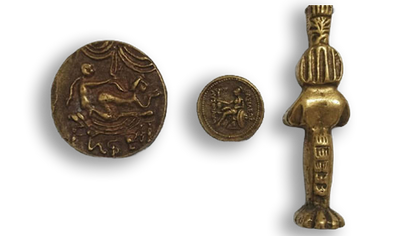
At a depth of approximately 3 meters, additional objects were uncovered:
- a bronze figurine
- several bronze coins
- a larger number of silver-colored coins
Many of these coins feature profile depictions and classical motifs reminiscent of ancient coinage.


Indications of a Historically Significant Site
The combination of figurative objects, inscribed stone structures, and metal finds at varying depths suggests the presence of a structured underground site. Based on the findings so far, the user assumes that it could be the tomb of a military commander. However, this assessment has not yet been conclusively confirmed.
The OKM Rover C4 in Practical Use
This discovery clearly demonstrates the capabilities of modern detection technology:
- 3D ground scans enable precise localization of objects.
- Structures can be identified before excavation begins.
- Signals from different depths can be clearly detected.
- Excavations can be planned efficiently.
In this case, the OKM Rover C4 not only provided the initial indications but also supported the entire process with reliable depth signals and clear scan images.
Conclusion: Modern Technology Meets Ancient History
This discovery highlights the performance of modern detectors like the OKM Rover C4, especially in archaeologically sensitive regions such as Mesopotamia.
At the same time, it preserves the fascination of such discoveries: step by step, hidden traces of past civilizations are brought to light — supported by technology that is more precise than ever before.
Get Rewarded for Your Treasure Finds
You have also made discoveries and detected amazing artifacts and would like to share them (anonymously)? We look forward to reading and publishing your success stories!

eXp 6000 Treasure Find Collection in Turkey
Coins, sculptures, jewelry and further artifacts were discovered with OKM eXp 6000 in Anatolia, Turkey. The artifacts can be dated ...

Silver Coins detected with Ground Scanner Rover C II in the Sechura Desert (Peru)
With the multi-purpose 3D metal detector OKM Rover C II it is possible to detect hidden metal artifacts in different ...

From Signal to Discovery: Roman Coin Hoard Found with Rover C4
Hidden beneath the surface: A Rover C4 scan leads to a sealed cavity filled with ancient Roman bronze coins and ...